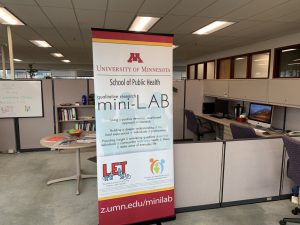
The Mini-Lab is a collaboration between the MCHB-funded Leadership Education and Training (LET) Program in MCH Nutrition and the Center.
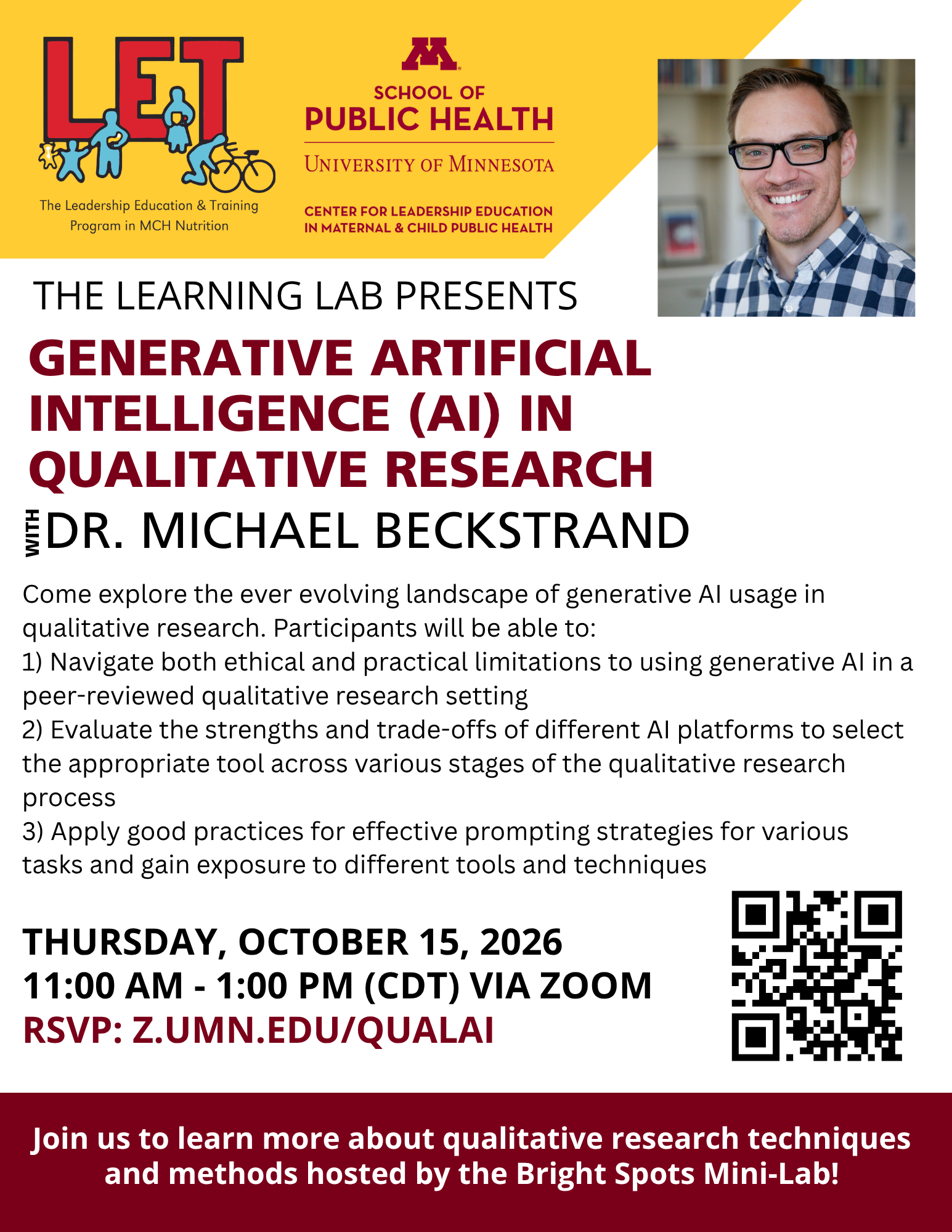
Fall 2026
Generative Artificial Intelligence (AI) in Qualitative Research with Dr. Michael Beckstrand
Thursday, October 15, 2026 | 11 am CT | Free, virtual, & open to all!
This fall, the Bright Spots Qualitative Mini-Lab will be welcoming Dr. Michael Beckstrand to host a hands-on presentation detailing use of artificial intelligence in the qualitative research space. Join us to explore the ever evolving landscape of generative AI usage in qualitative research. This session guides researchers through both the ethical and practical implementation of generative AI across the qualitative research process. Participants will learn effective prompting techniques, discuss guidelines for responsible practice, and consider the utility of chat bots versus built-in AI features within qualitative analysis software.
Past Sessions (2026):
- Using Ripple Effect Mapping (REM) to Understand the Impacts of a Public Health Partnership with Dr. Rebecca Shlafer, Dr. Scott Chazdon, and Ingie Osman
- Using Digital Storytelling for Community Engagement and Health Promotion with Dr. Abby Lohr and Graciela Porraz Capetillo on Thursday, February 19, 2026 from 11:00am-1pm CT
Past Sessions (2025):
- How to turn qualitative insights into compelling multimedia presentations–Quickly with Rich Thau on Thursday, January 30, 2025 from 11:30am-1pm CT
- Tips (and Tools) for Geospatial Storytelling with Melinda Kernik on Thursday, March 20, 2025 from 11am-1pm CT
- Shaping the Future of Public Health: Make Your Voice Heard with Abby Gold, Molly Immendorf, and Karen Ehrens on Thursday, May 8, 2025 from 11am-1pm CT
Past Fall Sessions (2024):
- Tips for Storytelling in Public Health (Part 1) with Dr. Richard Krueger on Thursday, September 19, 2024 from 11am-1pm CT
- Tips for Storytelling in Public Health (Part 2) with Dr. Richard Krueger on Thursday, October 31, 2024 from 11am-1pm CT