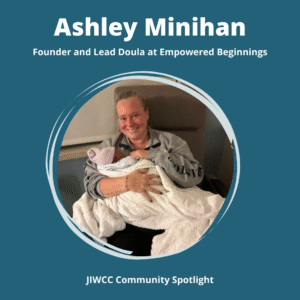
Ashley Minihan Founder and Lead Doula, Empowered Beginnings
Ashley Minihan is a doula, childbirth educator, and founder of Empowered Beginnings, a Connecticut-based organization providing holistic, community-centered support to families before, during, and after birth. Her work emphasizes education, trust, and connection to ensure parents feel informed and supported throughout the perinatal period. Ashley also provides doula support to pregnant and postpartum people who are incarcerated, addressing a critically under-resourced intersection of pregnancy, parenting, and the criminal legal system.
Note: This interview has been edited for length and clarity.
Can you share a bit about your journey into perinatal work and what inspired you to create Empowered Beginnings?
 I’ve been supporting families in some capacity for more than 25 years. I always thought I wanted to be a teacher, but once I became a parent and started going to parent-and-child groups, I realized that what I really loved was working with parents.
Before becoming a doula, I worked in a relationship-based home visiting program where I supported families from pregnancy through the time their children were five years old. In that role, I learned how important support and information are, especially when they come from someone you trust. I was working with families prenatally, but I wasn’t involved in their births. When I saw them again postpartum, there was so much birth trauma. People didn’t understand what had happened during their birth, and they were disconnected from their baby, their partner, and their postpartum experience. That’s what led me into birth work. It wasn’t really that I sought this profession out, it sort of found me.
Can you tell use more about Empowered Beginnings and your holistic approach to care?
We’re really a one-stop shop. Families can come in and see a chiropractor, meet with a lactation specialist, work with a pelvic floor therapist, attend childbirth classes, or join a postpartum group. Community has always been at the forefront of everything I’ve done. That was something that was really important to me as a first-time parent.
Being a parent is hard, and meeting people in the same season of life, at the same time, going through the same things can really reduce isolation. We build community through prenatal groups, postpartum groups, and classes, not just for parents, but for the doulas as well. That sense of connection is why the space came to be.
What inspired you to work with pregnant and parenting people who are incarcerated?
I’ve always had a passion for working with families who face unique challenges. I hadn’t really thought about the fact that people could be birthing while incarcerated until the State of Connecticut’s Office for Early Childhood reached out and presented this opportunity to me. After my first day working as a doula with this population, I was hooked. This role feels like the perfect fit because I’m able to help birthing people feel seen, heard, understood, supported, loved, and cared for.
What are some of the unique needs and challenges you see in this population?
Having a baby while incarcerated is probably one of the most traumatic things that a person can go through. Parents know they are going to be separated from their baby, and they often don’t get to make choices about their birth. They might not get to choose their child’s birthday because of an induction or a scheduled cesarean that they had no say in, and they don’t always know when appointments or procedures are happening. There’s so much uncertainty, and we don’t always have information to share. Supporting someone through something so unknown is incredibly challenging. Even when both the parent and the baby are healthy, they’re not leaving together, and that’s absolutely devastating.
How does education and advocacy show up in your work as a doula?
Providing families with information while they’re pregnant is essential. It enables them to have choices and empowers their experience so they can have a better connection with their baby. That’s true for every parent, regardless of their situation. I’ve seen this especially with birthing people who are on methadone. Even though the research clearly shows that babies should still receive breast milk, there’s often pushback. Because our moms are so well educated on the research, they’re able to advocate for themselves and their babies within the child welfare system and foster families. They’re saying “I know what the evidence is, and I know what the research says–my baby should have my milk.” And it works, their babies are getting their milk.
What do you hope readers take away from your story and this work?
My goal is to raise awareness and reduce stigma. These babies don’t deserve to be born into environments that aren’t kind to their parents. They deserve to be treated with kindness and love, and that only happens if their parents are treated with kindness and love. Even though we all wish these situations wouldn’t exist, we should offer the same amount of respect we offer anyone else because we are doing it for the babies.
Thank you to Ashley Minihan for sharing her time, insights, and dedication with JIWCC, and for her continued advocacy and care for families navigating pregnancy and parenting within the carceral setting.